What is a mesh network?
A mesh network is a group of radios that pass messages to each other. No towers. No subscriptions. No internet required. If you can hear another radio, you're on the network.
It sends text messages without relying on big tech
MeshCore is open-source software that turns inexpensive LoRa radios into a text messaging network. Messages hop from device to device until they reach their destination. The hardware draws almost no power and needs no license to operate.
Two roles: companion and repeater
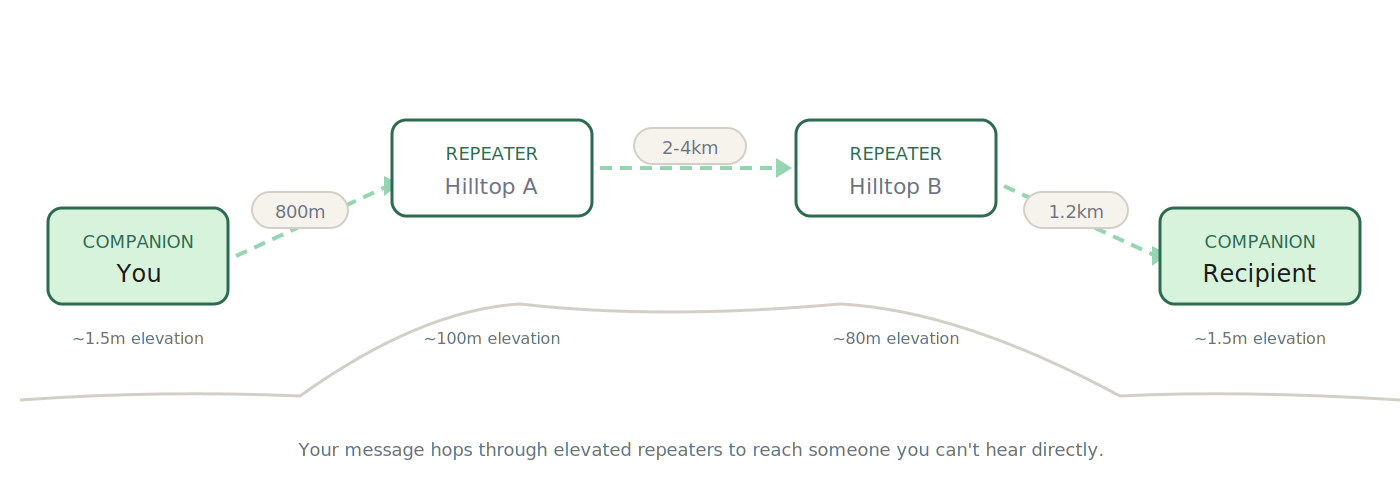
A MeshCore network has two primary roles to make the magic happen - the companion, a personal device which sends and receives messages, and the repeater, which receives and repeats signals. The same hardware can be configured as either role.
Multi-hop message delivery
Messages travel through the network hop by hop:
(1) Your companion sends a message.
(2) The nearest repeater picks it up and forwards it.
(3) The next repeater does the same.
This continues until the message reaches the destination. MeshCore uses intelligent routing to pick the best path, not flooding (where every node rebroadcasts everything).
Pair over Bluetooth, message like Signal
You carry a small radio. It pairs to your phone over Bluetooth. You open the MeshCore app on iOS or Android, and the interface looks and feels like any modern messaging app. You see contacts, channels, and a message thread. You type, you send, you get delivery confirmations.
MeshCore vs. Meshtastic
If you've been looking at mesh networking, you've probably seen Meshtastic. Both projects use the same LoRa radio hardware and the same frequencies. They solve the same basic problem. The difference is in how the network is built.
Neither is "better." They solve different problems. Meshtastic is great for ad-hoc, spontaneous use. MeshCore is what you build when you want a network that's still there tomorrow.